Friday, December 17, 2010

The Most Important Thing I Learned this Semester


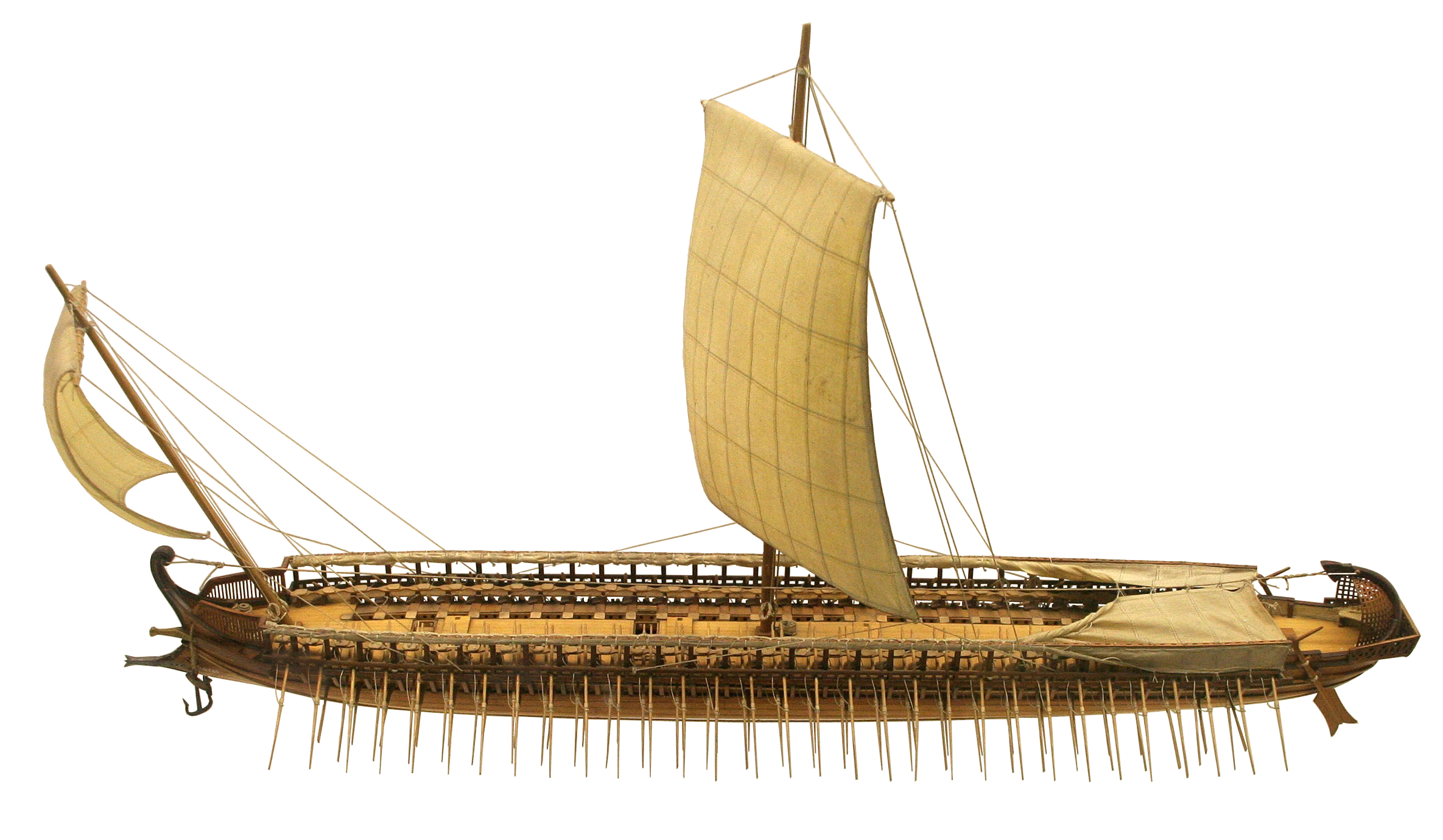
     Themistocles was a very important character in Greek history. He was not an aristocrat, but had to work his way up. Once he had done so, he flew. Themistocles was the one who realized Athens had extra money and should invest it to secure their safety. Under him, Athens bought many triremes, small boats seen above. The triremes were fast and maneuverable, meant to ram into bigger ships. Themistocles, instead of letting Athens run free with their newfound silver, bought these ships and gave Athens a navy. These came in handy when the Greeks became threatened by the Persians. The Athenians, with the help of Sparta's delaying tactics, destroyed the Persian navy because of these triremes. Themistocles was a hero.
     Because of this accomplishment, all powers of that time were scared of the Greeks. They had secured their safety and could now grow. Themistocles launched Athens into its golden Classical Age. It was now the ancient world's "Big Apple." But now that they were safe with no threat, out of the blue Athens got rid of Themistocles. They ostracised him. He was voted by the Athenian assembly into banishment. Ironically, he died in Persia, the very place he had once triumphed against. The most important things I've learned in history class this year are: that you can work your way up, to take risks, and to not get on people's nerves.

Friday, November 19, 2010

Greek Pantheon


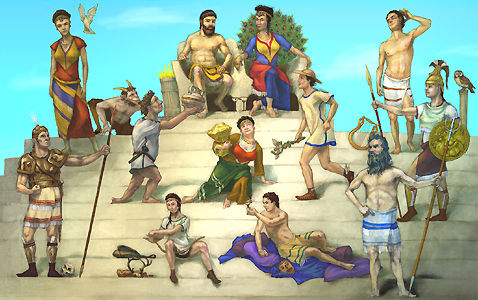
     The Greeks are famous for their polytheistic religion. They worshipped, feared, and loved the gods. Their pantheon consisted of twelve main gods and goddesses, called the Olympians, and a hundred more lesser deities. The Greeks' lives revolved around the gods, since they controlled everything. The main gods controlled the most important aspects of life, some more so than others.

     The head or king god was Zeus, the god of the sky. Known as Cloud-Gatherer, he could bring rain and thunderstorms. He was involved in many affairs but his wife was Hera, his sister. Beautiful Hera was the queen of the Olympians and the goddess of marriage and childbirth. In being the goddess of childbirth, Hera had her own children. One of her most famous children was Aphrodite, the goddess of love, lust, and beauty. Naturally, she was a Greek favorite. Aphrodite was married to Hephaestus, the lord of the forge and fire. He was a blacksmith and the god of technology. He had several brothers, one of which was Ares. Ares was the violent god of war who had several affairs with Hephaestus's wife Aphrodite. (Encyclopedia)

     Along with Aphrodite and Hephaestus was Apollo, the god of music, healing, and manly youth. His twin was Artemis, a huntress and goddess of nature and the moon. Also their sibling was Hermes, the messenger of the gods and transporter of the dead mortals to Hades. He was also the god of commerce, invention, and trickery. Last but not least in this family was Athena, goddess of wisdom, arts, and war. (Greek) But Zeus also had a few siblings besides Hera. One was Demeter, deity of fertility and harvest. She was calm and creative. Her calmness was unlike Poseidon, her brother. Poseidon was god of the sea and creator of earthquakes and horses. Another sibling was Hades, who didn't get a spot in the Olympians but was still important as he was the god of the underworld. The last direct sibling in this family was Hestia, goddess of homes. It is said that she gave up her throne on Mount Olympus to Dionysus, god of wine, parties, and enjoyment. (Buzzle)

     Different gods were patrons of different cities. For example, the Spartans valued war and therefore Ares was one of their patron gods. Obviously, Athena was the patron goddess of Athens, which focused on trade. Athena was one of the most important of the gods, since everyone wanted what she could offer: she used strategy in war and could give industrial gifts. Athena was also said to be Zeus's favorite child, although she knew this and tried to manipulate him in The Iliad to give her privileges.

     The Olympians were the most crucial deities who controlled main pieces of life. For example, Zeus controlled rainfall. Ares and Athena could cause success in battle. Most cities had patron gods or goddesses. The people of the cities would pray to that god the most, who usually reflected the city's goals and wants. The gods were essential to Greek life and influenced everything they did. In this way, we would be somewhere else without the Greek pantheon.
Saturday, October 23, 2010

Greek Architecture

     Architecture in Greece did not come around until around the 7th century BC, after its Dark Ages, when architecture was wood or mud houses. "Most of our knowledge of Greek architecture comes from the few surviving buildings of the Classical, Hellenistic, and Roman periods (since Roman architecture heavily copied Greek)." Greek architecture influenced Roman architecture, which then influenced American and other cultures universally. Without their unique additions of the columns, we would might still be living without them; the Greeks were brilliant.


      Greeks thought very highly of religion, so when they began architecting, "it is not surprising that the temples of ancient Greece were the biggest and most beautiful." (Ancient) In fact, one of the most famous Greek structures is the Parthenon, a temple (seen above). Constructing the Parthenon took only nine years to build, beginning in 447 BC and finishing by 438 BC, although decorating took another five years or so. (Parthenon) It was built by architects Iktinos and Kallikrates, by the order of Pericles, a politician of that time. It was actually a replacement after a former temple was destroyed by Persians, but it was also built to hold a statue of Athena. After all, it was her temple. The Parthenon is made of white marble and consists of 86 both Doric and Ionic columns, in a mainly Doric order. This gave the Parthenon a great balance of a strict yet delicate appearance.

     Ionic columns "communicate strength and dignity." (Columns) They are more complex than Doric columns, with intricate bases and slender shafts, creating a more elegant feel. Older, more common Doric columns are plainer with strict orders, dimensions, and numbers of flutes. They are more clean and pure in a way; no nonsense. The last type of the Greek columns, which wasn't used in the Parthenon, was the Corinthian column. It is similar to the Ionic, but is much more leafy. Its structure is intricately carved with foliage flowing upward to enhance its height. It has a bell-shaped capital, or top. Corinthian columns are much more fancy, and although more scarcely used in Greek times, they are used today in Washington D.C. and in many homes around the States. (Columns) 

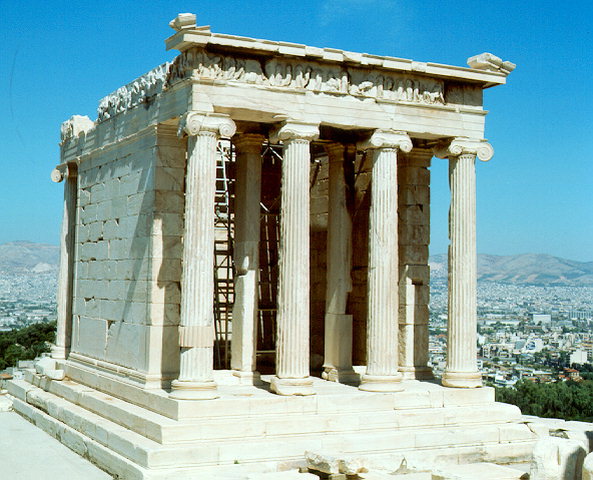
     "The Doric order was being developed in the seventh century BC and perfected in the fifth century during the construction of the Parthenon of Athens." (Columns) Around 500 BC Ionic pillars came along, and then by 400 BC, the Corinthian columns. An example of Ionic order is the Temple of Athena Nike below left, and the Temple of Zeus at Athens below right is of the Corinthian order.


     Architecture was very important to history. The Greeks built temples to gods that were central to their daily life, and in doing so, the created the column, which we still use very much today. They created three types of columns: Doric, Ionian, and Corinthian, getting more complicated and intricate as they progressed. The Romans took these, created more, and improved on them. Today Greek influence can be seen everywhere: from the original columns at the Parthenon to copied versions in Washington DC.